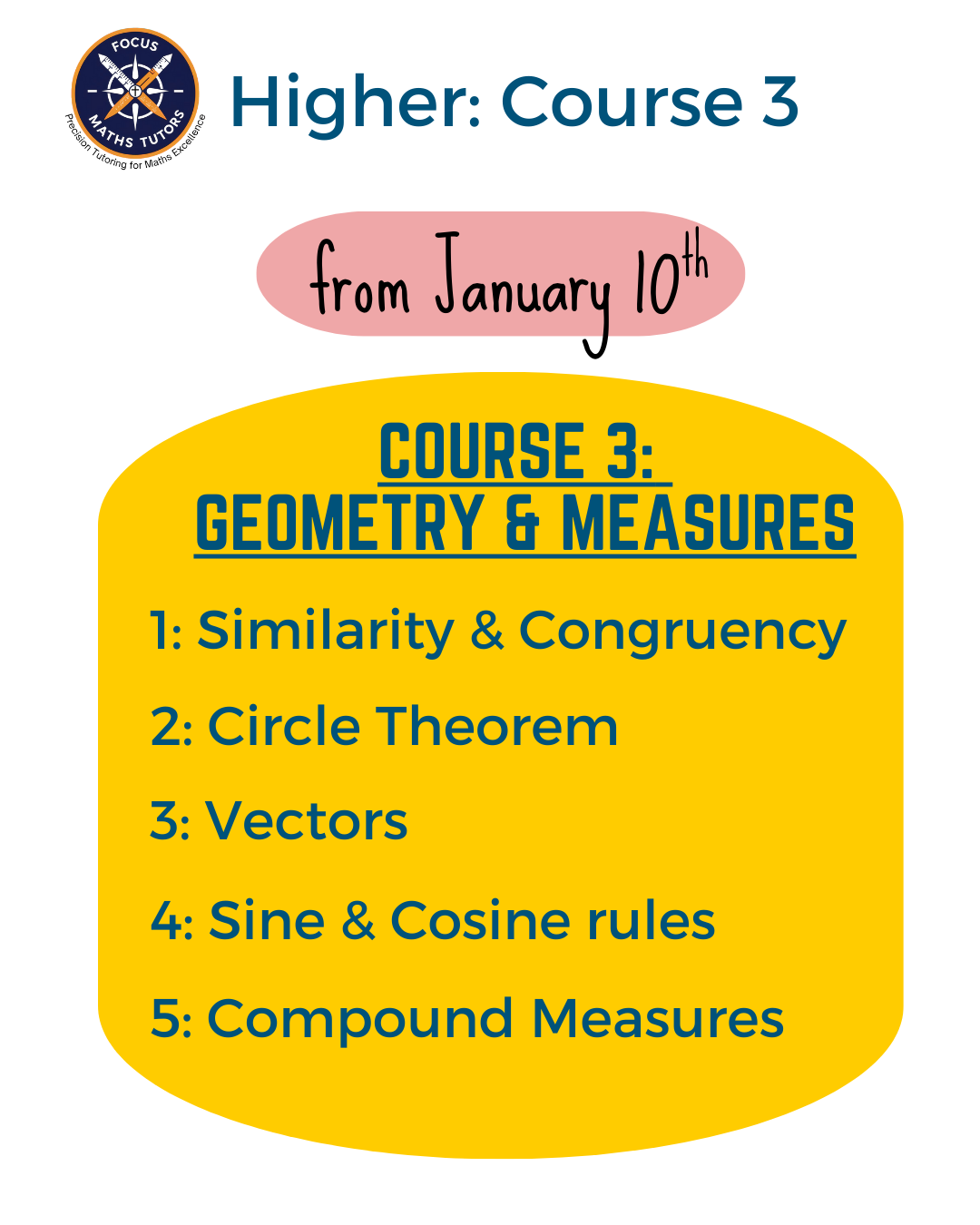
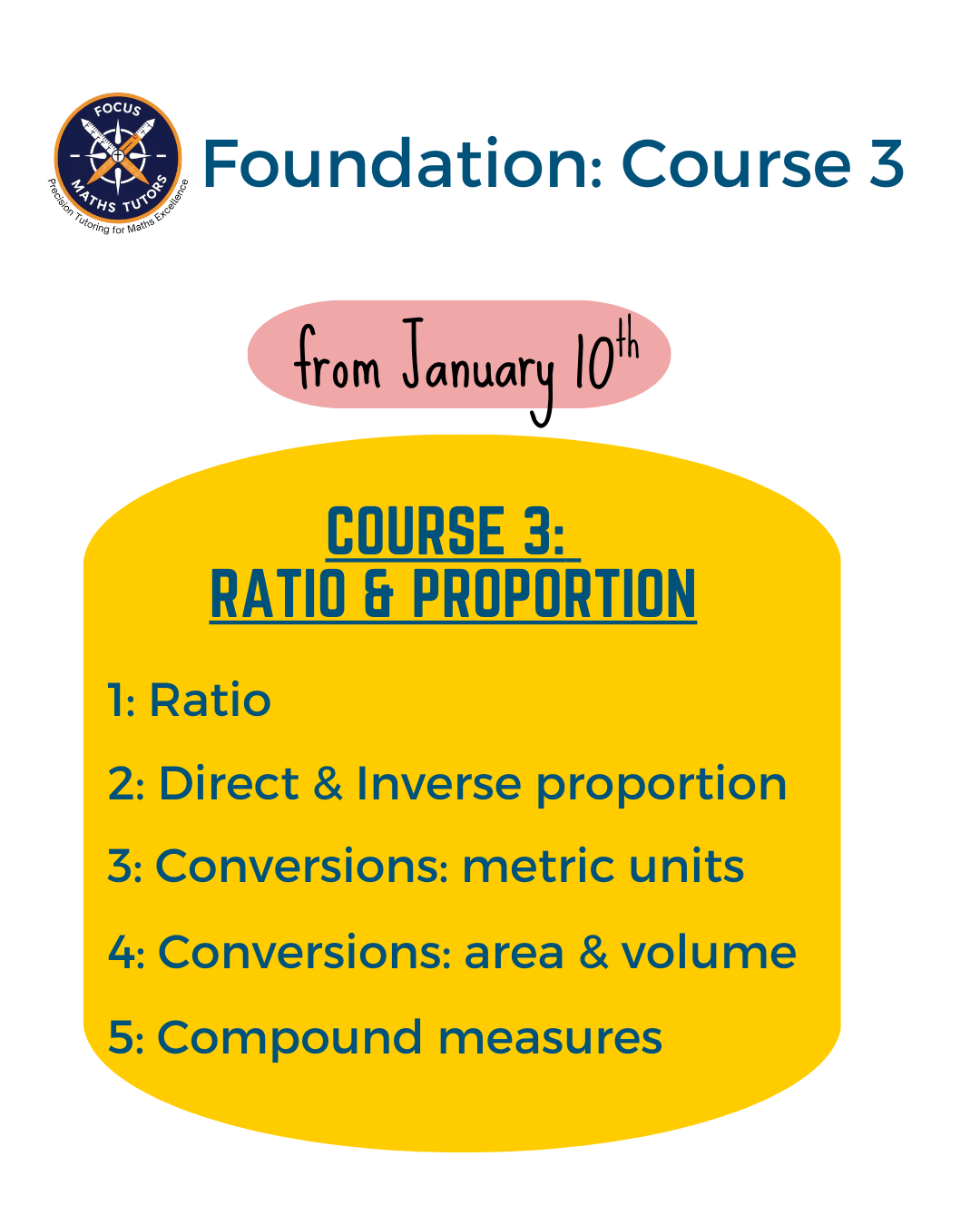
This course starts on the 10th January 2026
3. Geometry & Measures
01
Similarity & Congruency
Similarity and congruency are foundational geometric concepts that describe relationships between shapes.
Similarity focuses on figures that have the same shape but may differ in size, involving the ratio of corresponding lengths. Through similarity, it is possible to find unknown lengths of shapes by setting up proportional equations, which is especially useful in real-world applications such as scale drawings and models.
A linear scale factor describes how lengths change between two similar figures. When scaling up or down, this factor can be squared to determine the area scale factor, and cubed to find the volume scale factor. These relationships are used in calculations and problem solving, helping students compare surface areas and volumes of enlarged or reduced shapes with precision and confidence.
Congruency, on the other hand, identifies shapes that are identical in size and form—matching exactly when overlaid. Mastering these concepts helps learners to solve complex geometric problems and understand the underlying properties that connect different shapes.
Congruency plays a vital role in topics such as triangle proofs, transformations (especially reflections and rotations), circle theorems, and geometric reasoning.
02
Circle Theorems
Circle theorems provide powerful geometric rules that govern relationships within and around circles, and their proofs often rely on the foundational concepts of similarity and congruency.
For example, proving the angle in a semicircle involves recognising congruent triangles formed by radii and diameters, whilst the angles at the circumference theorem uses congruent arcs and isosceles triangles to establish equal angles. The intersecting chords theorem draws on similar triangles formed by overlapping segments, allowing proportional reasoning to emerge naturally.
By working through these proofs, pupils strengthen their logical reasoning and algebraic manipulation skills, whilst gaining deeper insight into how shapes relate through equal measures and consistent ratios.
Applying these theorems to problem solving enables learners to uncover unknown angles, lengths, and relationships within complex geometric scenarios—building the deductive precision and spatial awareness essential for success in mathematical studies.
03
Vectors
Vectors represent quantities with both magnitude and direction, and are essential tools in physics, engineering, and higher mathematics.
We will develop fluency in representing vectors using directed line segments and column notation, performing operations such as addition, subtraction, and scalar multiplication. These skills underpin the ability to model movements and forces both geometrically and algebraically. Learners should also be confident in calculating the magnitude of a vector, which enhances understanding of distance, speed, and direction in geometric contexts.
Solving vector problems involving ratios and position vectors equips pupils to tackle challenges where quantities are shared or divided proportionally—such as splitting velocities or locating points along a path.
Furthermore, applying vectors to geometric proofs—including demonstrating collinearity, parallelism, and congruency—strengthens logical reasoning and spatial awareness.
04
Sine & Cosine Rules
Sine and cosine rules extend trigonometric concepts beyond right-angled triangles, allowing the analysis and calculation of unknown sides and angles in any triangle.
Recapping trigonometry in right-angled triangles provides a solid foundation for understanding more general situations. Generalising to non right-angled triangles introduces powerful formulae—the sine rule, cosine rule, and area of triangle formula—which pupils must learn to apply accurately, including rearranging them and interpreting ambiguous cases.
Using these rules in problem solving empowers learners to tackle real-world scenarios and complex calculations involving navigation, engineering, and design, whilst developing essential skills in algebraic fluency, spatial reasoning, and structured geometric argument.
Learners should also be able to apply a combination of these rules to solve problems involving 3D shapes, such as pyramids and triangular prisms, where multiple triangles intersect within spatial structures.
05
Compound Measures
Compound measures connect different physical quantities using mathematical formulae, allowing meaningful interpretation and calculation in science and everyday life.
Being able to identify and work with Speed-Distance-Time formulae as well as Density-Mass-Volume formulae is essential for solving practical problems in physics, engineering, and daily activities.
The ability to extend the same concept to other compound measures, such as pressure or flow rate, develops versatility in measurement and analysis.
Moreover, knowing how to convert compound units—for example, from km/h to m/s or g/cm³ to kg/m³—ensures clarity and consistency when working with data from diverse sources.

Telephone: +44 07466 980 795
E-mail: info@focusmathstutors.co.uk