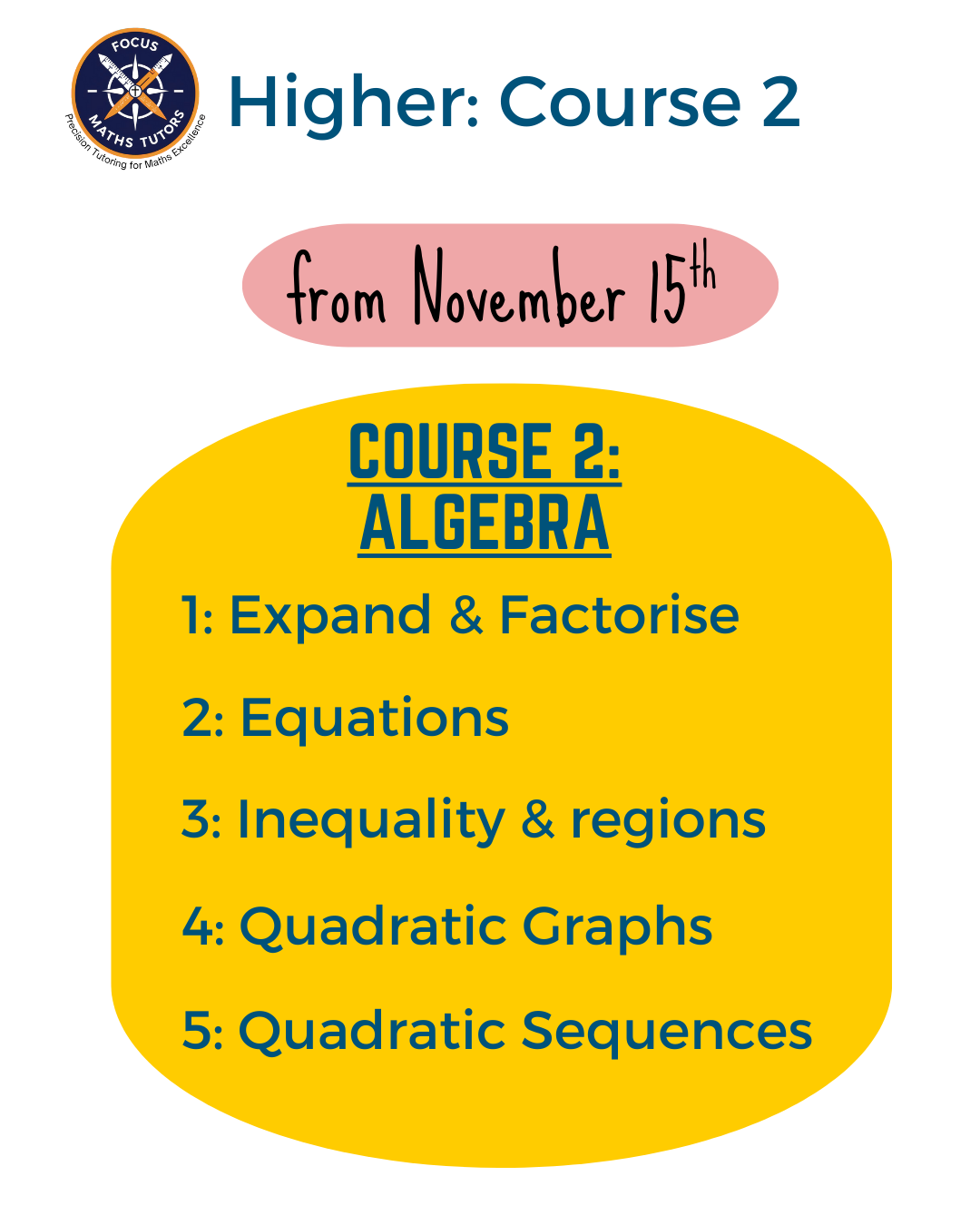
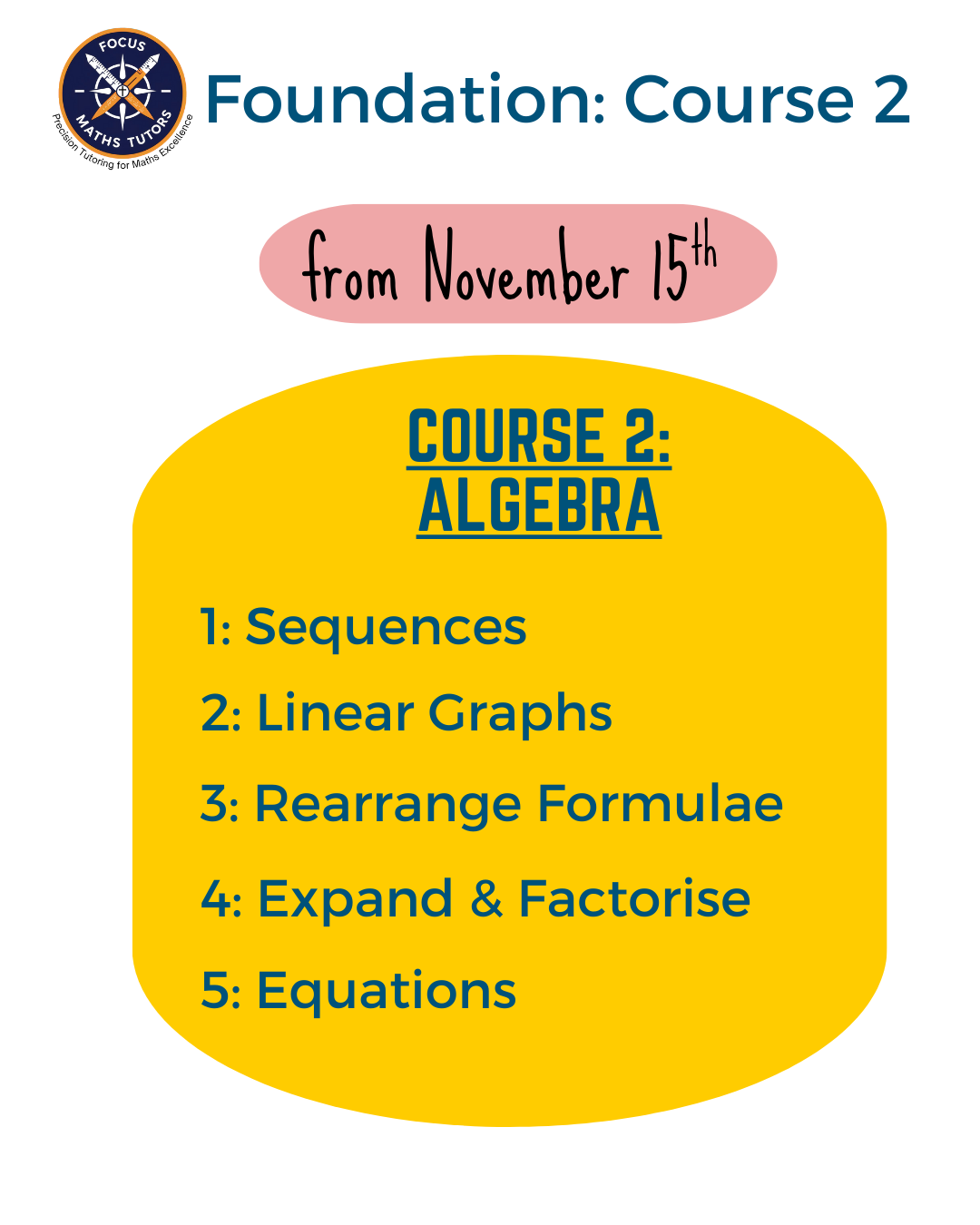
This course starts on the 15th November 2025
2. Algebra
01
Expand & Factorise
Expanding and factorising are fundamental algebraic skills that enable manipulation of polynomial expressions across various levels of complexity.
Expanding expressions with 1, 2 or 3 brackets develops systematic approaches to distributive multiplication and prepares students for complex algebraic manipulations.
The ability to factorise all types of quadratic expressions including difference of 2 squares provides powerful tools for solving equations and simplifying expressions, with the difference of squares pattern offering elegant solutions to specific quadratic forms.
Completing the square represents a sophisticated technique that not only aids in solving quadratic equations but also reveals the vertex form of parabolas, bridging algebraic manipulation with geometric understanding and providing foundation skills for calculus.
02
Equations
Solving equations requires systematic approaches and multiple solution strategies to handle increasingly complex mathematical relationships.
Solving difficult linear equations builds algebraic fluency and logical reasoning skills essential for advanced mathematics, involving multiple steps and various algebraic manipulations.
The skill of solving quadratic equations by factorising, by completing the square and with the formula provides students with three distinct methods for tackling second-degree polynomials, ensuring flexibility and understanding of when each approach is most effective.
Mastery of these diverse equation-solving techniques enables students to model and solve real-world problems involving parabolic relationships and quadratic optimization scenarios.
03
Inequality & Regions
Inequalities and regions extend equation-solving skills to represent ranges of solutions and constraint-based problems.
Solving linear inequalities and identifying solutions on a graph develops understanding of solution sets and their visual representation on number lines and coordinate planes.
The ability to plot a set of linear inequalities on a graph and identify the region that satisfies all inequalities introduces students to linear programming concepts and constraint optimization, skills that are essential in economics, engineering, and operations research.
These techniques provide powerful tools for modelling real-world situations where multiple conditions must be satisfied simultaneously.
04
Quadratic Graphs
Quadratic graphs represent parabolic relationships that appear throughout mathematics, science, and engineering applications.
Completing table of values for quadratic equations develops systematic approaches to function evaluation and prepares students for graph construction.
The skill of plotting quadratic graphs and identifying roots and y-intercepts connects algebraic expressions with their geometric representations, enabling students to visualize solutions and understand the relationship between factored form and graph features.
Understanding these graphical representations is essential for interpreting motion under constant acceleration, optimization problems, and various mathematical modelling scenarios.
05
Quadratic Sequences
Quadratic sequences bridge the gap between linear patterns and more complex mathematical relationships found in polynomial functions.
Finding the nth term rule for a linear sequence provides foundation skills that extend naturally to quadratic patterns, building systematic approaches to sequence analysis.
Completing a quadratic sequence develops pattern recognition for second-order differences and prepares students for understanding polynomial growth rates.
The ability to link quadratic sequences to quadratic graphs connects discrete mathematics with continuous functions, while finding the nth term rule for a quadratic sequence provides powerful tools for predicting terms and understanding the mathematical structure underlying complex numerical patterns.


Telephone: +44 07466 980 795
E-mail: info@focusmathstutors.co.uk