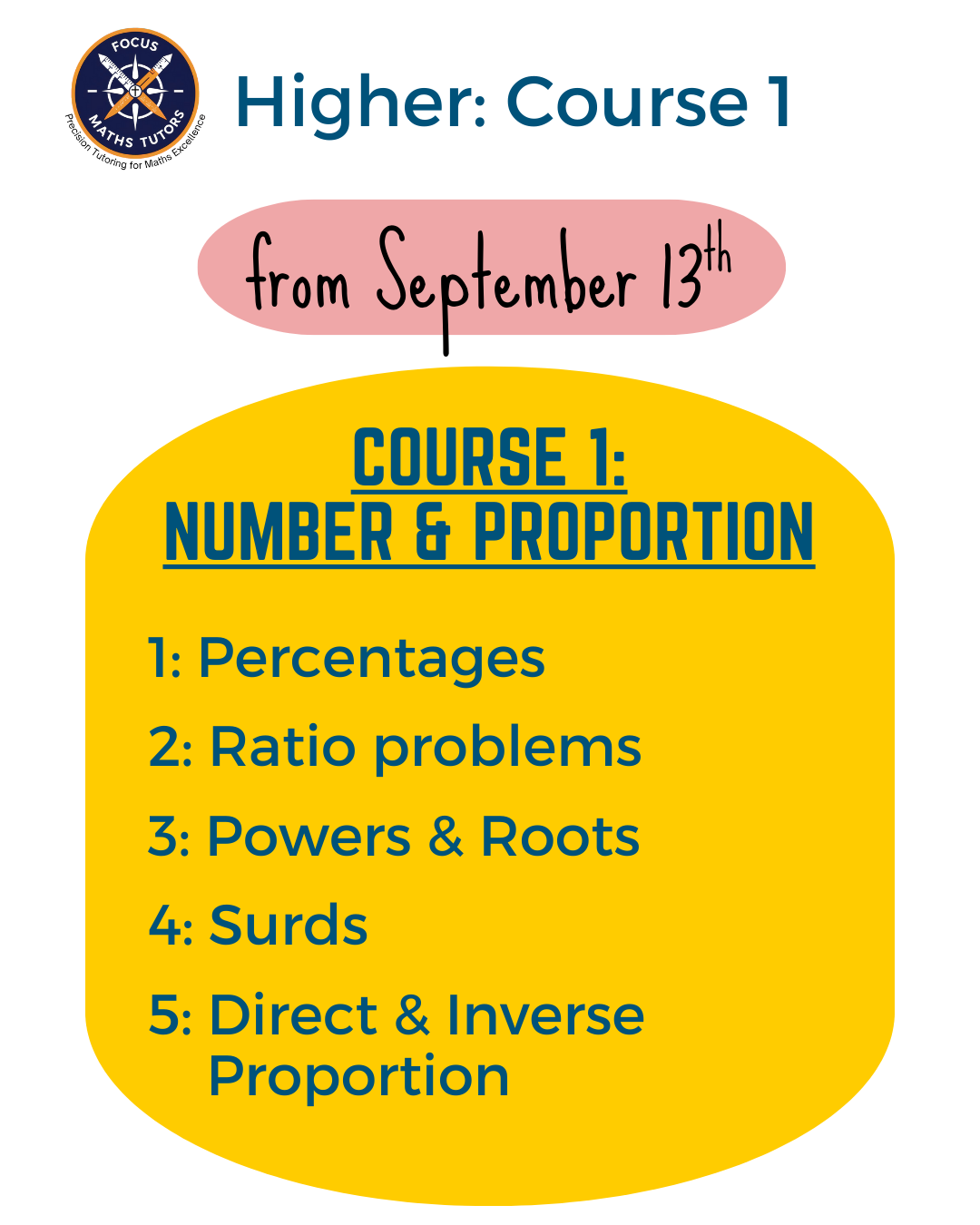
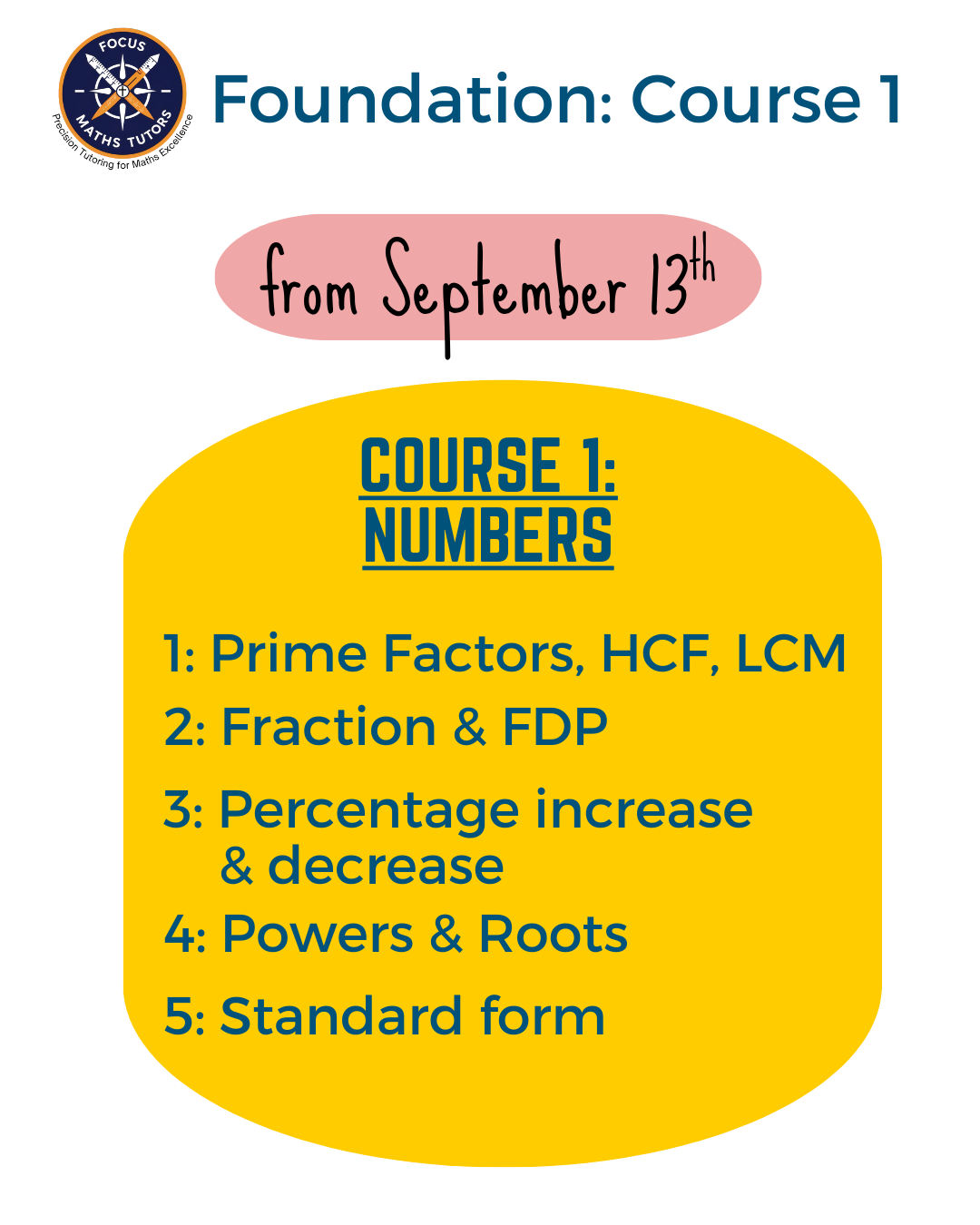
This course starts on the 13th September 2025
1. Numbers & Proportion
01
Percentages
Percentages are essential for interpreting and comparing quantities in everyday life and mathematics.
Calculating the percentage of an amount allows us to determine proportions, such as discounts or statistical results.
Percentage increase and decrease are vital tools for analysing growth or decline in financial, economic, and scientific contexts, while compound interest and depreciation demonstrate how repeated percentage changes accumulate or diminish values over time.
The concept of reverse percentages enables the determination of original values before changes were applied, which is particularly useful in financial recovery calculations and data analysis.
Mastery of these skills equips pupils to solve complex problems relating to personal finance, business, and data interpretation.
02
Ratio
Working with ratios is fundamental for expressing relationships between quantities and sharing items fairly.
Equivalent ratios show how two ratios can represent the same relationship, and writing ratios in the form m:n provides a clear format for comparison and allocation.
Mastering all scenarios of sharing in ratio such as Sharing in a Part:Part Ratio, Sharing in a Part:Whole Ratio and Sharing in a Ratio with Known Share (Unitary Method) equips learners to solve a variety of real-world problems, including splitting resources, dividing inheritances, or distributing costs fairly.
Incorporating ratio in algebraic context enriches problem-solving capabilities, allowing the manipulation and expression of ratios through variables and equations for more advanced mathematical situations.
03
Powers & Roots
Powers and roots form the mathematical foundation for expressing repeated operations and their inverses, essential for advanced mathematical study and scientific calculations.
Developing fluency in arithmetic with laws of indices including negative powers enables efficient manipulation of exponential expressions, such as simplifying expressions or performing calculations with negative exponents.
The ability to convert between fractional powers and roots and use them for calculations provides flexible approaches to complex problems, such as expressing roots in exponential form or calculating fractional powers.
These skills are fundamental for scientific notation problems, compound interest calculations, and modelling exponential relationships in physics, chemistry, and finance where precise manipulation of powers is essential for accurate results.
05
Direct & Inverse Proportion
Direct and inverse proportion help describe relationships where two quantities scale together or in opposite directions.
Solving recipe problems using proportion ensures accurate scaling of ingredients for any number of servings.
With direct proportion using formula and finding the constant of proportionality, understanding and applying the formula allows identification and calculation of the constant of proportionality, essential for predicting changes.
Inverse proportion using formula after finding the constant of proportionality reveals how one value changes as another increases or decreases, once the constant of proportionality has been established.
These techniques are invaluable for mathematical modelling in science, engineering, and economics, making sense of real-world relationships and changes.
04
Surds
Surds are irrational roots that cannot be precisely expressed as fractions, providing exact values in mathematical expressions.
Simplifying surds and performing arithmetic operations—such as adding, subtracting, multiplying, or dividing—require proficiency with factorisation and root properties.
Estimating a surd involves approximating its value for practical use, while rationalising denominators removes surds from the denominator of fractions, making expressions cleaner and easier to work with.
Grasping these concepts strengthens the ability to solve a wide range of algebraic and geometric problems with precision.

Telephone: +44 07466 980 795
E-mail: info@focusmathstutors.co.uk