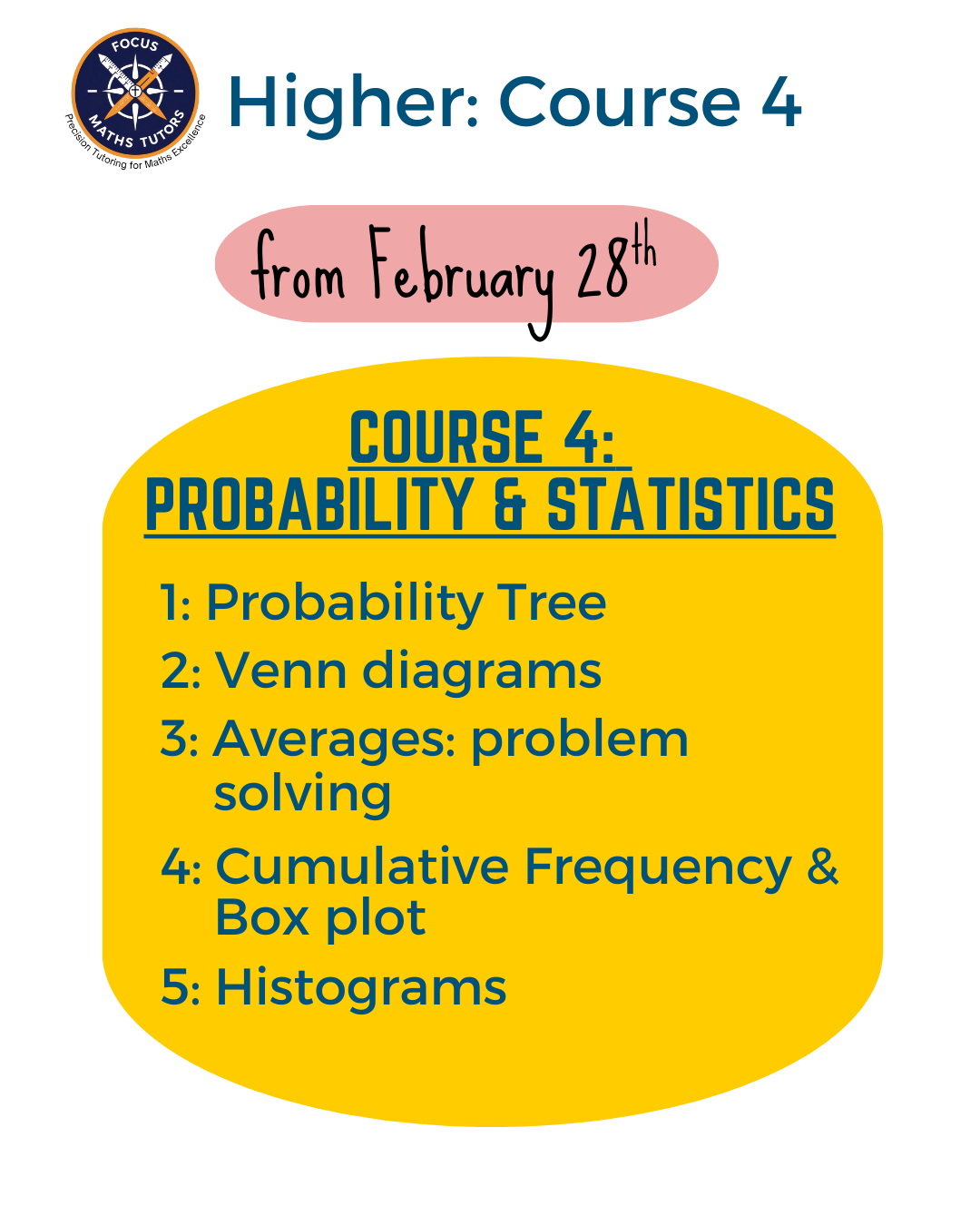
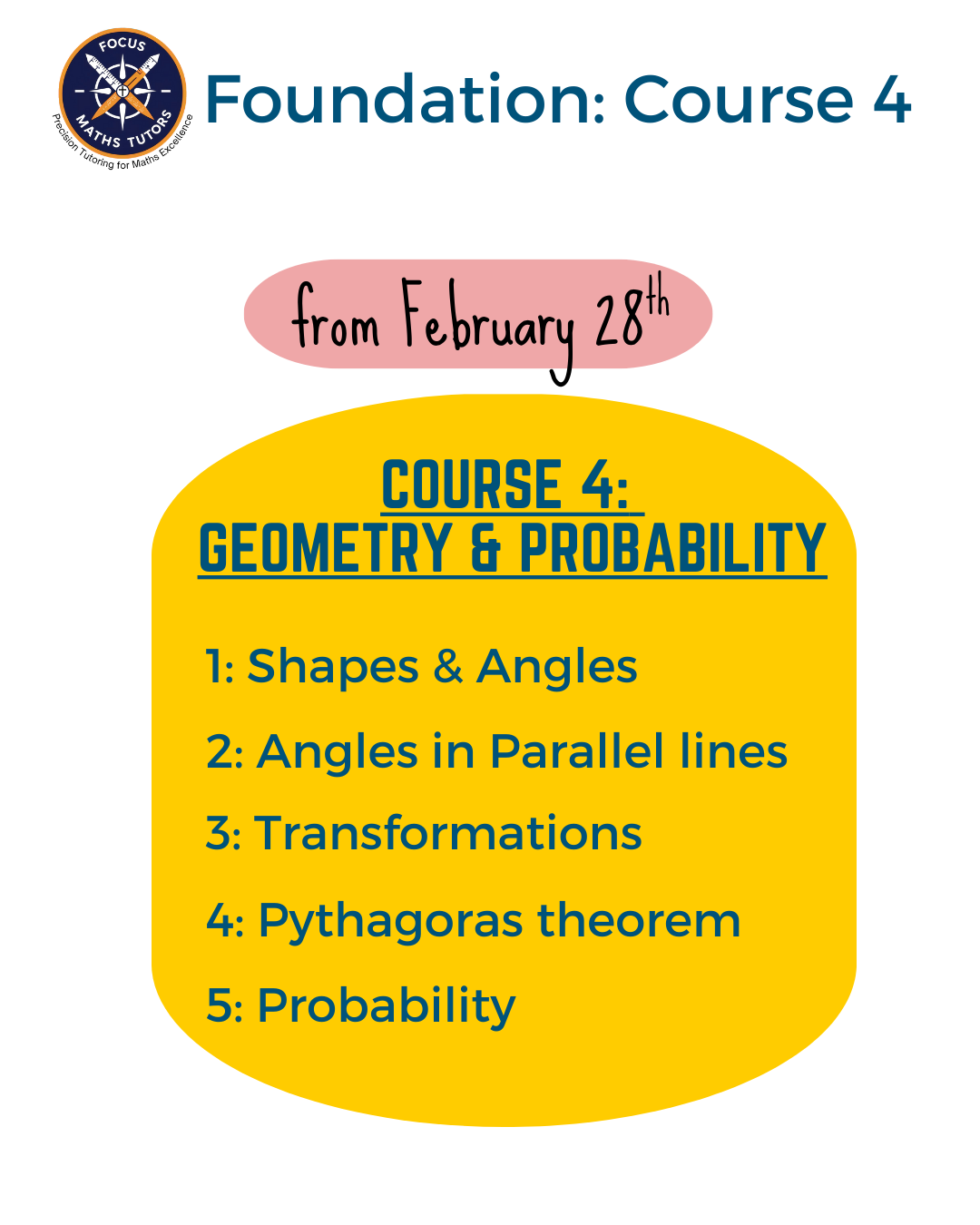
This course starts on the 28th February 2026
4. Geometry & Probability
01
Shapes & Angles
Shapes and angles provide the essential foundation for understanding geometric relationships and spatial reasoning.
Pupils must master basic facts about triangles, learning that all triangles have interior angles totalling 180°, with specific types including equilateral, isosceles and scalene triangles.
They also learn fundamental properties of quadrilaterals, understanding that all four-sided shapes have interior angles summing to 360°, and recognising special quadrilaterals such as squares, rectangles, parallelograms and trapeziums.
Pupils must understand basic angle rules for polygons, beginning with the key principle that exterior angles of any polygon always sum to 360°, while interior angles can be calculated using the formula (n−2)×180°, where n represents the number of sides, and apply these rules to problem-solving questions.
02
Angles in Parallel Lines
Angles in parallel lines provide students with essential tools for solving geometric problems by recognizing specific angle relationships. When a transversal (a straight line) cuts through two parallel lines, it creates eight angles with predictable relationships that students must learn to identify and apply.
Students must master three key angle relationships: corresponding angles are equal and form an "F-shape" pattern, alternate angles are equal and create a "Z-shape" pattern, and allied angles add up to 180° and form a "C-shape" pattern.
Learners practice identifying these angle patterns systematically, learning to spot the F, Z, and C shapes even when diagrams are rotated or presented in unfamiliar orientations.
These skills prove essential for solving examination problems involving parallel lines and transversals, where students must state the angle rule used at each step and demonstrate logical reasoning.
Students also learn to combine parallel line angle rules with other basic angle facts such as angles on a straight line (180°), vertically opposite angles (equal), and angles around a point (360°) to solve multi-step problems involving complex geometric configurations.
03
Transformation
Transformations will cover reflection, translation and rotation.
Students must master how to describe and draw reflections, learning that when a shape is reflected across a mirror line.
Students practice identifying reflection lines including vertical lines (x = a), horizontal lines (y = b), and diagonal lines such as y = x, using techniques such as drawing the mirror line first, then plotting reflected points by counting squares away from the line.
Students develop competency in describing and drawing translations, where shapes slide horizontally and vertically without rotation or reflection, using vector notation such as (4/3) to represent "4 units right and 3 units up"
Students must learn to describe transformations fully by identifying the type of transformation (reflection, translation, rotation, or enlargement) and providing complete details.
Students will practice with coordinate grids, learning to plot transformed shapes accurately by applying transformations to individual vertices and connecting the new points to create the image.
04
Pythagoras Theorem
Pythagoras theorem is one of the most important mathematical relationships that students must master for solving problems involving right-angled triangles.
Students learn that the theorem states: "In any right-angled triangle, the square of the hypotenuse (longest side) equals the sum of the squares of the other two sides, "expressed as the formula a² + b² = c², where c represents the hypotenuse and a and b represent the two shorter sides.
Students must develop competency in identifying the hypotenuse as the side opposite the right angle and always the longest side of the triangle, then applying the correct formula depending on which side they need to find. Learners then practice applying Pythagoras theorem to find missing lengths in right-angled triangles, learning systematic approaches for different scenarios. .
Students also learn to identify whether triangles contain right angles by checking if the squares of the two shorter sides add up to the square of the longest side.
They apply these skills to practical problem-solving contexts including calculating distances between coordinates, finding heights and lengths in real-world scenarios such as ladder problems, and determining diagonal lengths in rectangles
05
Probability
Probability provides pupils with mathematical tools to measure and analyse chance and uncertainty in everyday situations.
Pupils must master basic probability calculations and express results as fractions, decimals or percentages on a scale from 0 (impossible) to 1 (certain). Pupils practise calculating probabilities for simple events such as rolling dice, drawing cards or spinning wheels, learning that all probabilities in a complete set must sum to 1.
Pupils must demonstrate competency in using Venn diagrams to organise and visualise relationships between different sets of outcomes, enabling them to find probabilities for events that may overlap or remain separate. They practise placing numbers or outcomes in the appropriate regions of Venn diagrams, identifying intersections (events that happen together) and unions (events where at least one occurs), then calculating probabilities by counting favourable outcomes within specific regions.
Pupils also learn to construct and interpret tree diagrams for multi-step probability experiments, where each branch represents a possible outcome with its associated probability, and use these diagrams to calculate probabilities of combined events by multiplying along branches for “and” scenarios and adding probabilities for “or” scenarios.

Telephone: +44 07466 980 795
E-mail: info@focusmathstutors.co.uk