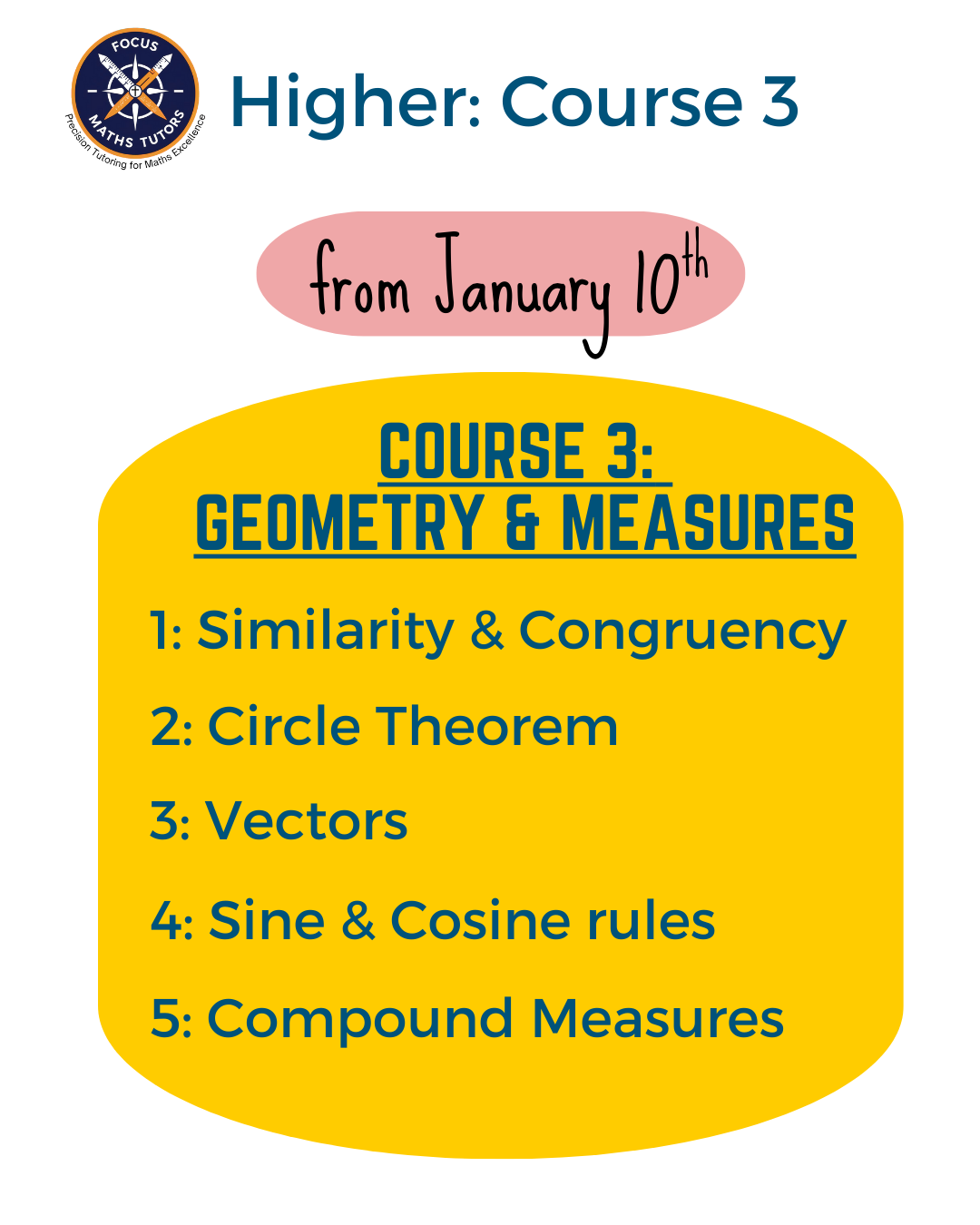
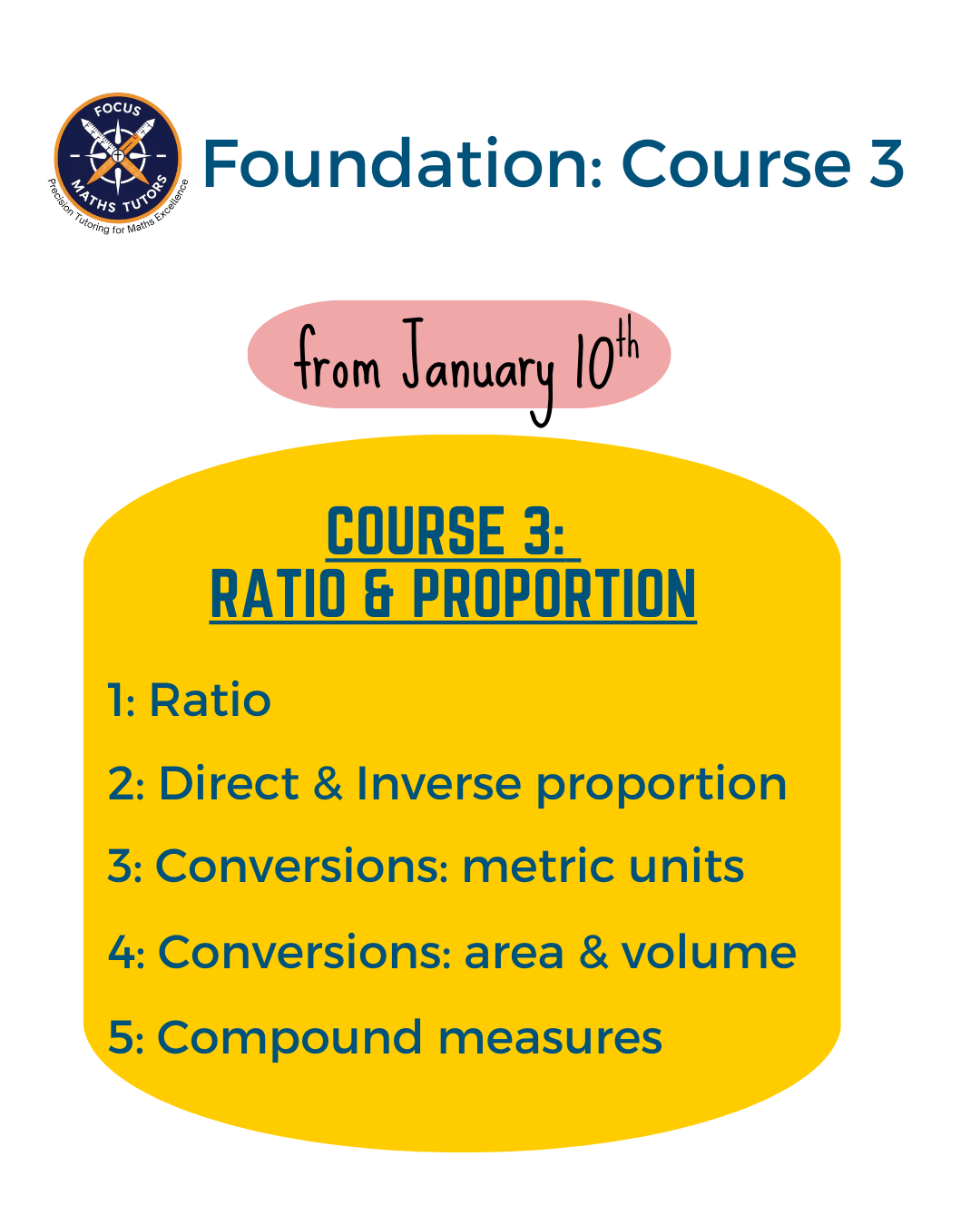
This course starts on the 10th January 2026
3. Ratio & Proportion
01
Ratio
Ratio provides a systematic way for students to compare and share quantities proportionally, serving as an essential tool for problem-solving in everyday contexts.
Students must master the ability to simplify ratios by dividing all parts by their highest common factor, making comparisons clearer and calculations more manageable. Equivalent ratios enables students to recognize that different pairs of numbers can represent the same proportional relationship.
Students also learn to express ratios as fractions, bridging proportional reasoning with fractional arithmetic, deepening understanding of how parts relate to wholes.
Learners must demonstrate competency in sharing quantities using different ratio scenarios. Part:Part ratio sharing involves dividing amounts where students add ratio parts together, find the value of one part, then multiply by each ratio number Part:Whole ratio problems require understanding that one part of the ratio represents a portion of the total, while the other represents the remainder. The unitary method with known shares enables students to work backwards when given one person's share to find the total amount or other shares.
02
Direct & Inverse Proportions
Understanding direct proportion enables students to recognize when quantities increase or decrease together at the same rate.
Students learn to apply recipe scaling problems using proportional reasoning, where doubling ingredients produces double the servings, developing fluency with the unitary method by finding the amount per person first, then scaling up or down accordingly.
Students will practice best buy problems to determine the most economical shopping choices by calculating cost per unit (such as price per 100g) or quantity per pound, comparing different package sizes and special offers to identify genuine value.
Working with direct proportion problem-solving develops systematic approaches where students recognize that if one quantity doubles, the related quantity also doubles, building confidence through real-world contexts like converting currencies, calculating fuel costs, and determining hourly wages.
Inverse proportion scenarios, including workforce allocation problems, introduce students to situations where increasing one quantity decreases another proportionally - for example, "if 2 workers take 6 hours to complete a task, then 3 workers take 4 hours".
03
Conversions: metric units
Metric unit conversions are fundamental skills that students must master for practical everyday calculations and problem-solving.
Students learn to convert confidently between units of length (millimetres to centimetres, centimetres to metres, metres to kilometres), understanding that each conversion involves multiplying or dividing by a power of 10 depending on the direction of conversion.
Similarly, mastering conversions between units of mass (grams to kilograms) and capacity (millilitres to litres) enables students to handle real-world scenarios such as cooking measurements, medicine dosages, and shopping quantities with accuracy and confidence.
Students also develop competency in converting between metric and imperial units for common measurements, learning approximate conversions such as 1 inch ≈ 2.5 cm, 1 foot ≈ 30 cm, 1 kg ≈ 2.2 pounds, and 1 litre ≈ 1.75 pints, which proves essential for interpreting recipes and solving practical problems in contexts where both systems are used.
04
Conversions: Area & Volume
Area and volume unit conversions are essential skills that help students tackle practical problems involving space and measurement.
Students learn to understand metric units of area such as square millimetres (mm²), square centimetres (cm²), and square metres (m²), recognizing that these units measure the amount of space inside 2D shapes.
Similarly, mastering metric units of volume including cubic centimetres (cm³), cubic metres (m³), and their relationship to capacity units like millilitres and litres (where 1 ml = 1 cm³ and 1 litre = 1000 cm³) enables students to work confidently with 3D measurements.
Students must develop fluency in converting between these units using squared and cubed scale factors.
Applying these area and volume units in practical calculations allows students to solve real-world problems such as determining how much paint is needed for walls, calculating the capacity of containers, finding the amount of material required for construction projects, and working out storage space requirements.
05
Compound Measures
Compound measures combine two different physical quantities using mathematical formulae, helping students understand how measurements relate to each other in practical situations.
Students must master Speed-Distance-Time calculations using the formula Speed = Distance ÷ Time, enabling them to solve everyday problems such as calculating journey times, average speeds for car trips, or determining how far someone travels in a given time period. Students learn to use formula triangles as memory aids, covering the quantity they want to find and using the remaining two values to perform the calculation.
Equally important is understanding Density-Mass-Volume relationships through the formula Density = Mass ÷ Volume, which helps students tackle problems involving the heaviness of materials, comparing different substances, and understanding why some objects float while others sink.
Converting compound units proves essential for practical applications - for example, changing speed from kilometres per hour to metres per second by converting each unit separately (1 km = 1000 m, 1 hour = 3600 seconds), then combining these conversions.


Telephone: +44 07466 980 795
E-mail: info@focusmathstutors.co.uk