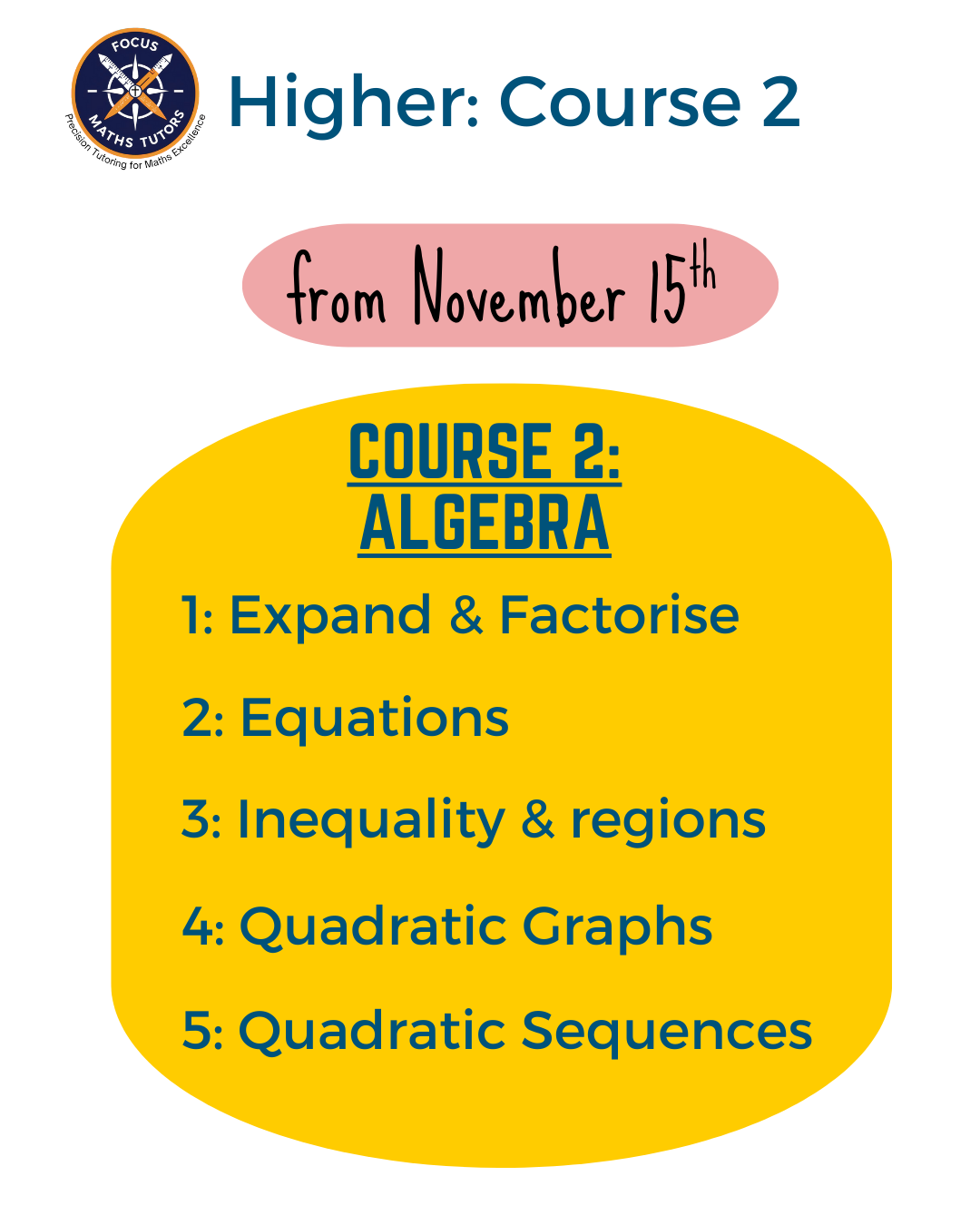
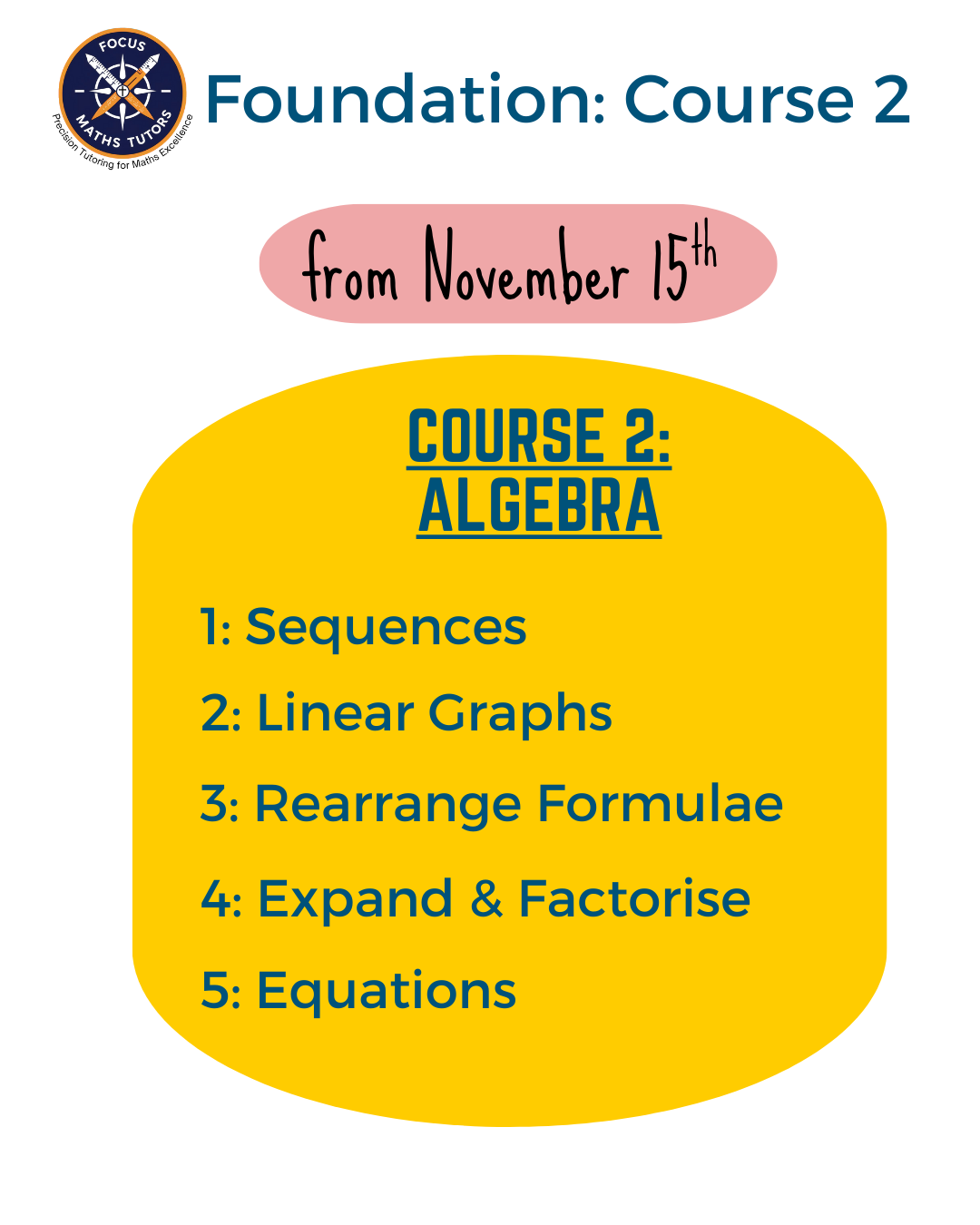
This course starts on the 15th November 2025
2. Algebra
01
Sequences
Sequences are ordered lists of numbers that follow specific patterns, forming the foundation for understanding mathematical relationships and predictions.
Learning to continue or find missing terms in a linear sequence develops pattern recognition skills essential for algebraic thinking.
The ability to find the nth term rule for a linear sequence provides a powerful tool for determining any term's value without listing all preceding terms.
Completing a Fibonacci sequence introduces students to one of mathematics' most famous patterns, where each term is the sum of the two preceding terms.
Completing a geometric sequence and finding the common ratio explores exponential growth and decay patterns, where each term is multiplied by a constant factor, preparing students for advanced topics in algebra and calculus.
02
Linear Graphs
Linear graphs constitute the fundamental visual representation of proportional relationships between variables.
The essential skill of identifying equations of graphs in the form x = a and y = b and drawing them establishes comprehensive understanding of vertical and horizontal line relationships on the coordinate plane, where x = a represents vertical lines and y = b represents horizontal lines.
Students must demonstrate mastery in identifying gradient and y-intercept from y = mx + c and drawing graphs by completing tables of values, where the gradient m represents the rate of change or steepness of the line, and the y-intercept c indicates where the line crosses the y-axis, enabling efficient interpretation and construction of linear relationships through systematic coordinate plotting.
The advanced ability to find equations of lines when given gradient and a point or when given two points provides students with essential analytical tools for modelling real-world situations involving rates of change and linear relationships.
03
Rearrange Formulae
Rearranging formulae is a vital algebraic skill that enables students to solve for any variable within an equation by systematically applying inverse operations.
Working through up to four steps, including those with fractions, builds clear problem-solving strategies: students learn to maintain balance by performing the same operation on both sides of an equation, converting addition to subtraction, multiplication to division, and powers to roots.
Mastering formula rearrangement allows students to adapt a single relationship to answer different questions, enhancing their flexibility with models in science, finance, and geometry.
Employing the “solving by reading” approach and the function-machine method offers visual, step-by-step frameworks for reversing processes, making complex manipulations more intuitive and boosting confidence in algebraic reasoning.
04
Expand & Factorise
Expanding and factorising are foundational algebraic techniques that underpin all work with polynomials.
Proficiency in expanding single and double brackets, including subsequent simplification, ensures students can apply the distributive law accurately—essential for manipulating expressions such as (x + 3)(2x – 5) and simplifying results like 2x² + x – 15.
Equally important is factorising expressions with a single common factor across multiple terms, which teaches students to recognise and extract greatest common factors—streamlining longer expressions and setting the stage for more complex reversals of expansion.
Moving beyond straightforward cases, factorising simple quadratics of the form ax² + bx + c develops students’ ability to decompose binomials into two expression factors, a skill directly linked to solving quadratic equations by finding roots and understanding how polynomial structure dictates solution sets.
05
Equations
Equations form the backbone of algebraic problem-solving, requiring systematic application of inverse operations to maintain equality and develop logical reasoning.
Students begin by solving linear equations, including those with negative coefficients, fractions, and multi-step scenarios, thereby reinforcing computational fluency and confidence in manipulating diverse algebraic expressions.
Advancing to quadratic equations, students learn to factorise polynomials of the form ax² + bx + c into linear factors, enabling precise determination of roots and analysis of parabolic behaviour in real-world contexts such as projectile motion, structural engineering, and economic modelling.


Telephone: +44 07466 980 795
E-mail: info@focusmathstutors.co.uk