
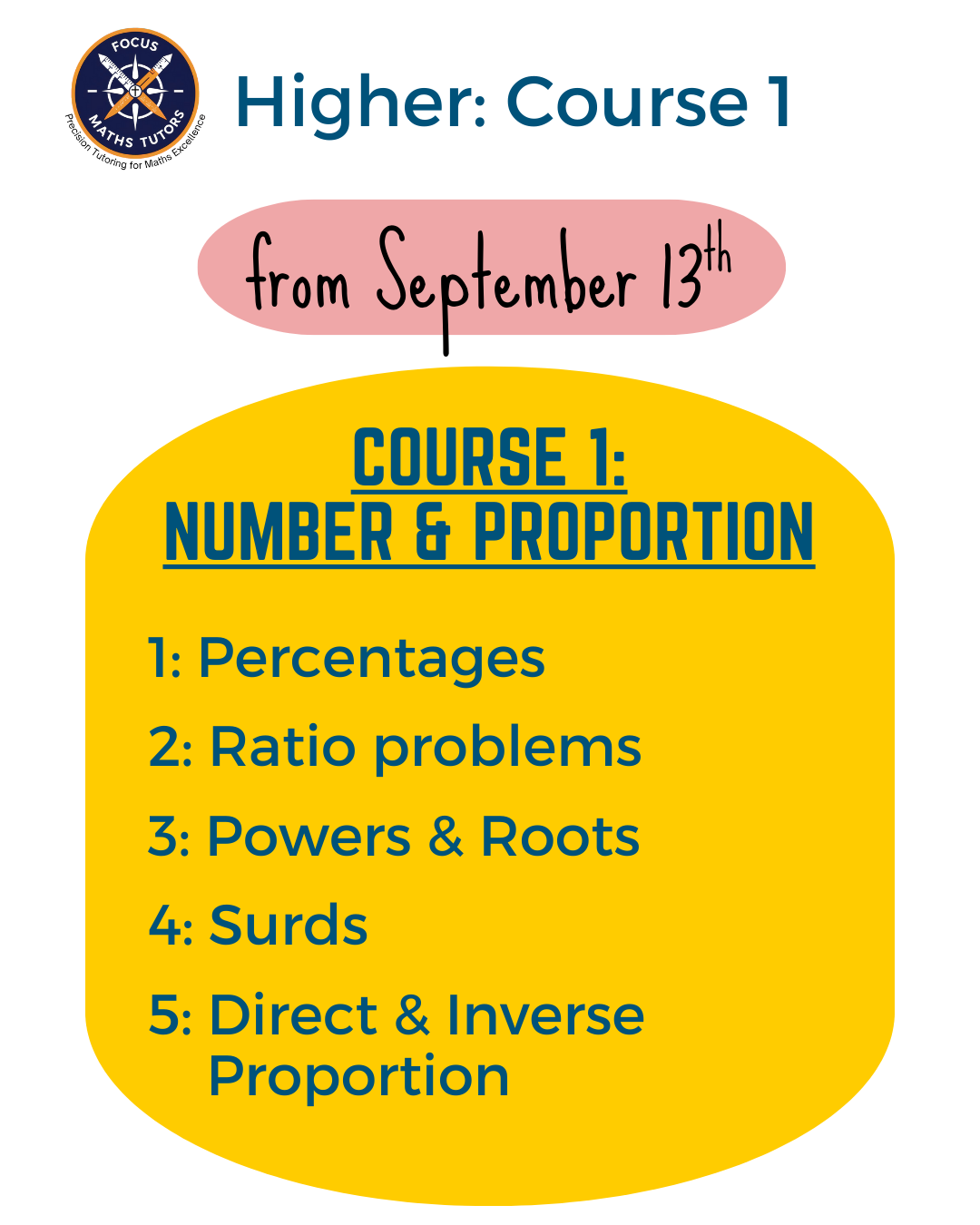
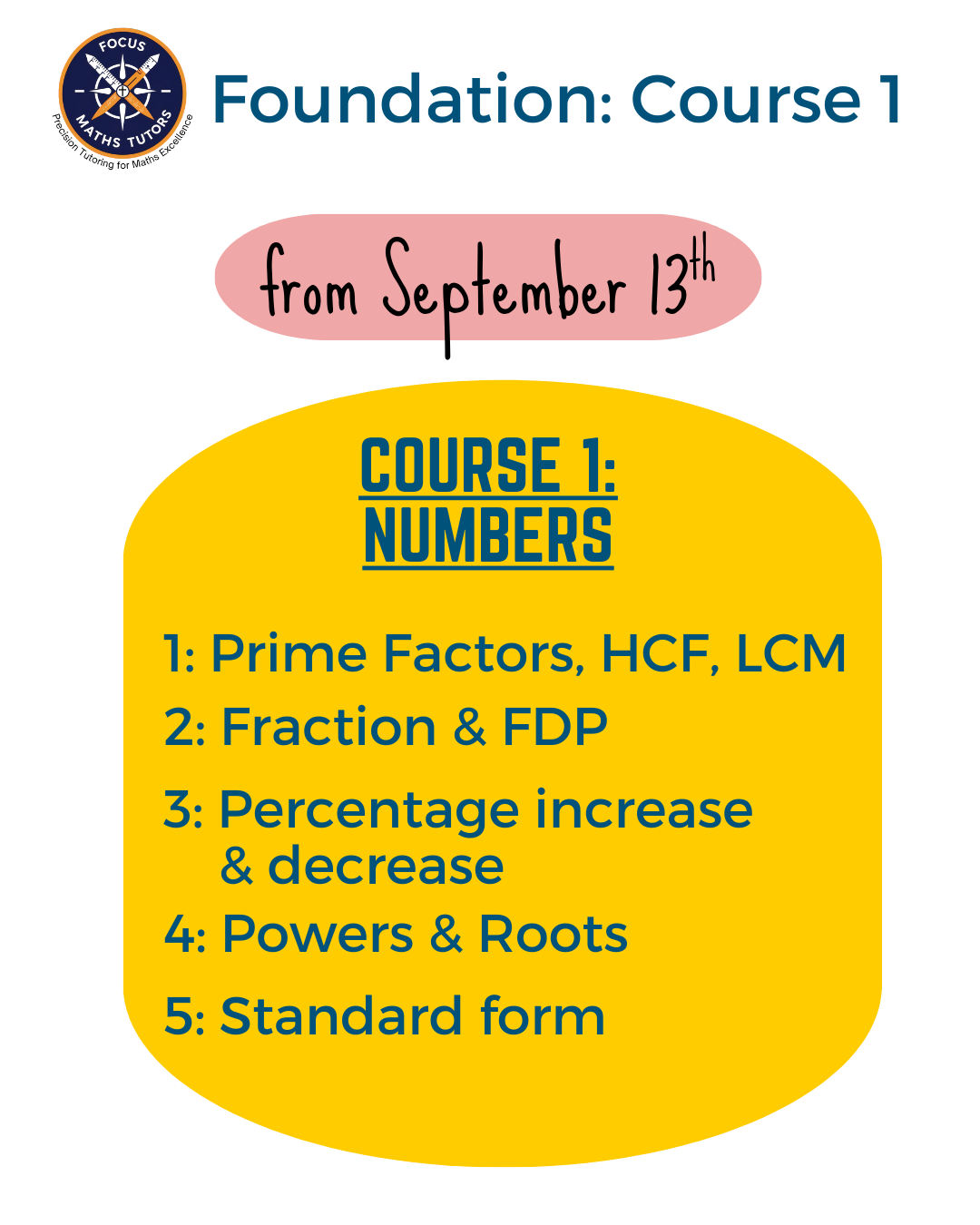
This course starts on the 13th September 2025
1. Numbers
01
Prime Factors, HCF, LCM
Prime factors, HCF, and LCM form the foundation of number theory and provide essential tools for understanding mathematical relationships between integers.
Learning to define a prime number establishes the building blocks of all natural numbers, while the ability to write a number as a product of prime factors reveals the unique mathematical fingerprint of each integer.
Mastering techniques to find LCM and HCF enables students to solve practical problems involving common multiples and factors, which is essential for working with fractions, scheduling problems, and optimization scenarios.
Problem solving cases involving HCF and LCM appear frequently in real-world contexts such as finding when events will coincide or determining the most efficient ways to package or distribute items.
02
Fraction & FDP
Fractions and FDP (Fractions, Decimals, Percentages) represent different ways of expressing parts of a whole and are fundamental to mathematical literacy across all levels.
Developing fluency in arithmetic with fractions and algebraic fractions builds computational skills essential for algebra and higher mathematics. The ability to convert between fractions, decimals and percentages provides flexibility in problem-solving and enhances understanding of proportional relationships.
Understanding how to define a decimal multiplier simplifies percentage calculations and provides an efficient method for finding parts of quantities, making financial calculations and data analysis more accessible and accurate.
03
Percentages
The multiplier method provides an efficient approach to percentage calculations by converting percentages into decimal multipliers—for example, a 15% increase uses multiplier 1.15, while a 20% decrease uses multiplier 0.8.
Learning to find the percentage of an amount using the multiplier eliminates complex fraction calculations and enables quick, accurate computation.
Mastering techniques to find percentage increase and decrease enables pupils to analyse trends, calculate interest, and understand proportional changes over time.
The skill of reverse percentage calculations allows determination of original values before changes occurred, which is particularly valuable in financial recovery calculations and discount analysis.
Pupils develop confidence with fundamental percentage concepts including converting between percentages, decimals, and fractions, using mental calculation strategies for common percentages, and applying these skills to real-world contexts such as sales, discounts, and financial planning.
05
Standard Form
Standard form provides an essential notation system for expressing very large and very small numbers efficiently, particularly important in scientific and technological contexts.
Learning to convert between ordinary form and standard form enables clear communication of quantities ranging from atomic scales to astronomical distances.
The skill to compare numbers in standard form allows accurate ordering and analysis of data across vastly different scales.
Mastering arithmetic such as adding, subtracting, dividing and multiplying with standard form including problem solving equips pupils to handle calculations involving scientific measurements, population statistics, and technological specifications with precision and confidence.
04
Powers & Roots
Powers and roots form the mathematical language for expressing repeated multiplication and its inverse operations, essential for algebra and scientific notation.
Developing proficiency in arithmetic with laws of indices—including negative powers—enables efficient manipulation of exponential expressions and provides foundation skills for logarithms and advanced algebra.
The ability to convert between fractional indices and roots and use them for calculation bridges the gap between radical notation and exponential form, offering flexible approaches to complex problems.
These skills are fundamental for scientific calculations, compound interest problems, and modelling exponential growth and decay phenomena. We will also briefly touch on surds arithmetic to reinforce your understanding of irrational roots and their manipulation.


Telephone: +44 07466 980 795
E-mail: info@focusmathstutors.co.uk